What's New in OpenUBA
A complete rewrite with enterprise-grade features for security operations, powered by modern AI and data engineering.
Role-Based Access Control
Fine-grained RBAC with permission-based navigation. Control who sees what across the entire platform.
LLM AI Agent
Built-in AI assistant powered by LLMs. Ask questions, get insights, and automate investigation workflows.
Rule Studio
Visual flow-graph rule builder for complex detection logic. Drag-and-drop nodes to create sophisticated alert rules.
Real-Time Alerts
Rules fire alerts in real-time. Investigate, triage, and escalate anomalies as they happen.
K8s Model Orchestration
Kubernetes-native operator with custom CRDs. Ephemeral containers for model training and inference jobs.
Job Logging & Monitoring
Real-time training and inference job logs with GraphQL subscriptions. Monitor model performance live.
The OpenUBA Dashboard
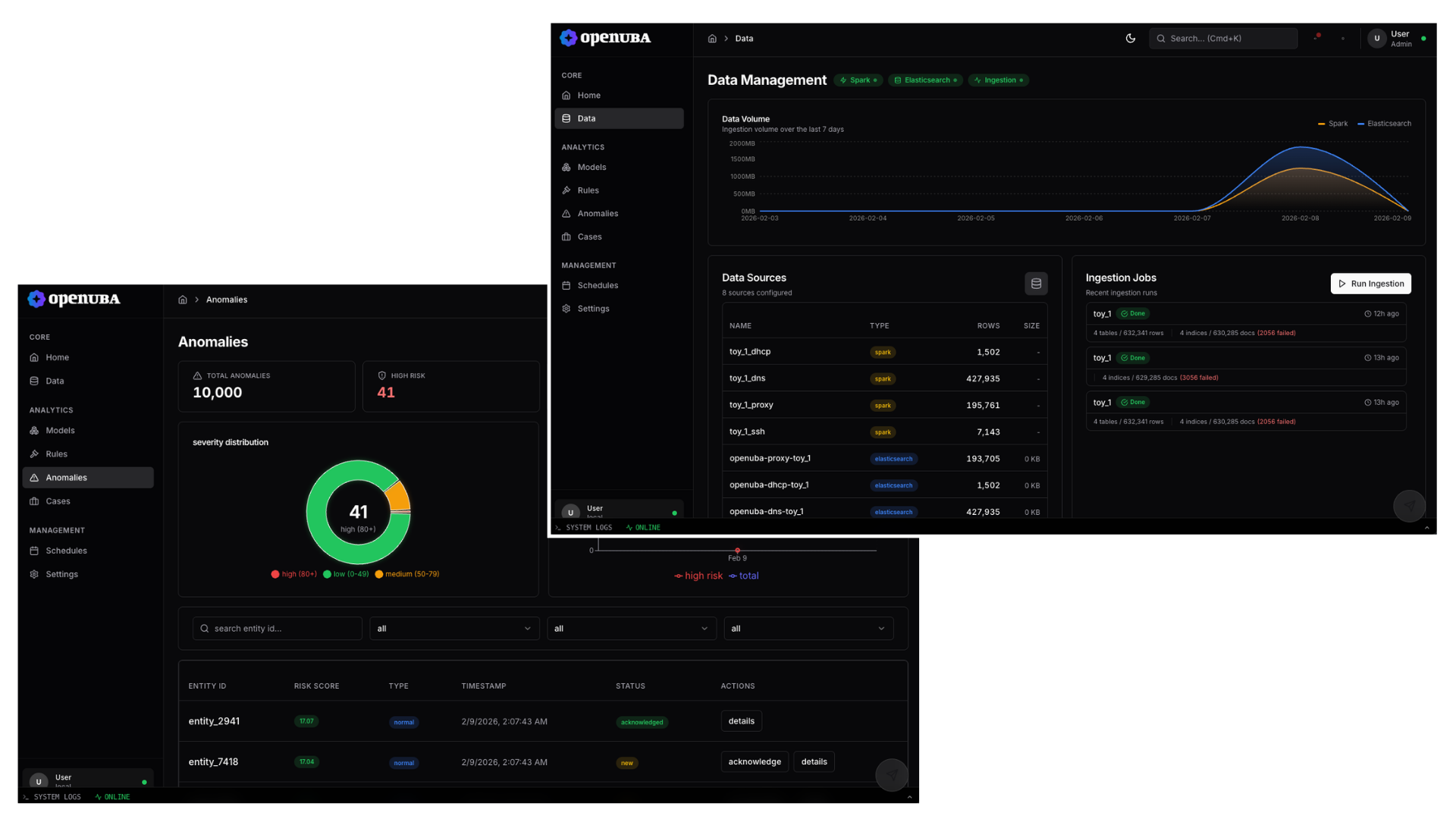
A unified security operations interface for monitoring user behavior, managing data pipelines, and investigating anomalies at scale.
Entity Monitoring
Track 10,000+ users with real-time risk scoring and behavioral baselines across your entire organization.
Anomaly Detection
Surface high-risk users and anomalous behavior patterns automatically with ML-powered models.
Multi-Source Ingestion
Connect Spark, Elasticsearch, and CSV data sources. Monitor ingestion volumes and job status live.
Risk Trending
Visualize security risk over time with interactive charts. Spot escalations before they become incidents.
Job Orchestration
Run ingestion and model training jobs on demand. Track completion status, row counts, and failures.
Case Management
Investigate anomalies with built-in case workflows. Triage, escalate, and resolve from a single pane.
Open Model Standard
Every model follows a simple, standardized interface. A model.yaml for configuration and a MODEL.py with train() and infer() methods.
1name: model_sklearn
2version: 1.0.0
3runtime: sklearn
4description: Isolation Forest Anomaly Detection
5parameters:
6  contamination:
7    type: float
8    default: 0.1
9  random_state:
10    type: integer
11 default: 421class Model:
2 def train(self, ctx) -> Dict[str, Any]:
3 X = ctx.df.select_dtypes(include=[np.number]).values
4 self.model = IsolationForest(contamination=0.1)
5 self.model.fit(X)
6 return {"status": "success", "n_samples": len(X)}
7
8 def infer(self, ctx) -> pd.DataFrame:
9 predictions = self.model.predict(X)
10 scores = self.model.decision_function(X)
11 return pd.DataFrame(results)Model Library
Browse community-driven anomaly detection models. Install them like packages — each model follows the Open Model Standard.
How It Works
From raw data to actionable intelligence — OpenUBA handles the full detection pipeline.
Ingest
Connect to Elasticsearch, Spark, or CSV data sources
Analyze
Run anomaly detection models on K8s
Score
Generate risk scores and classifications
Act
Visualize, alert, and investigate in the dashboard
Resources
Blog posts, architecture deep dives, and announcements from the OpenUBA project.